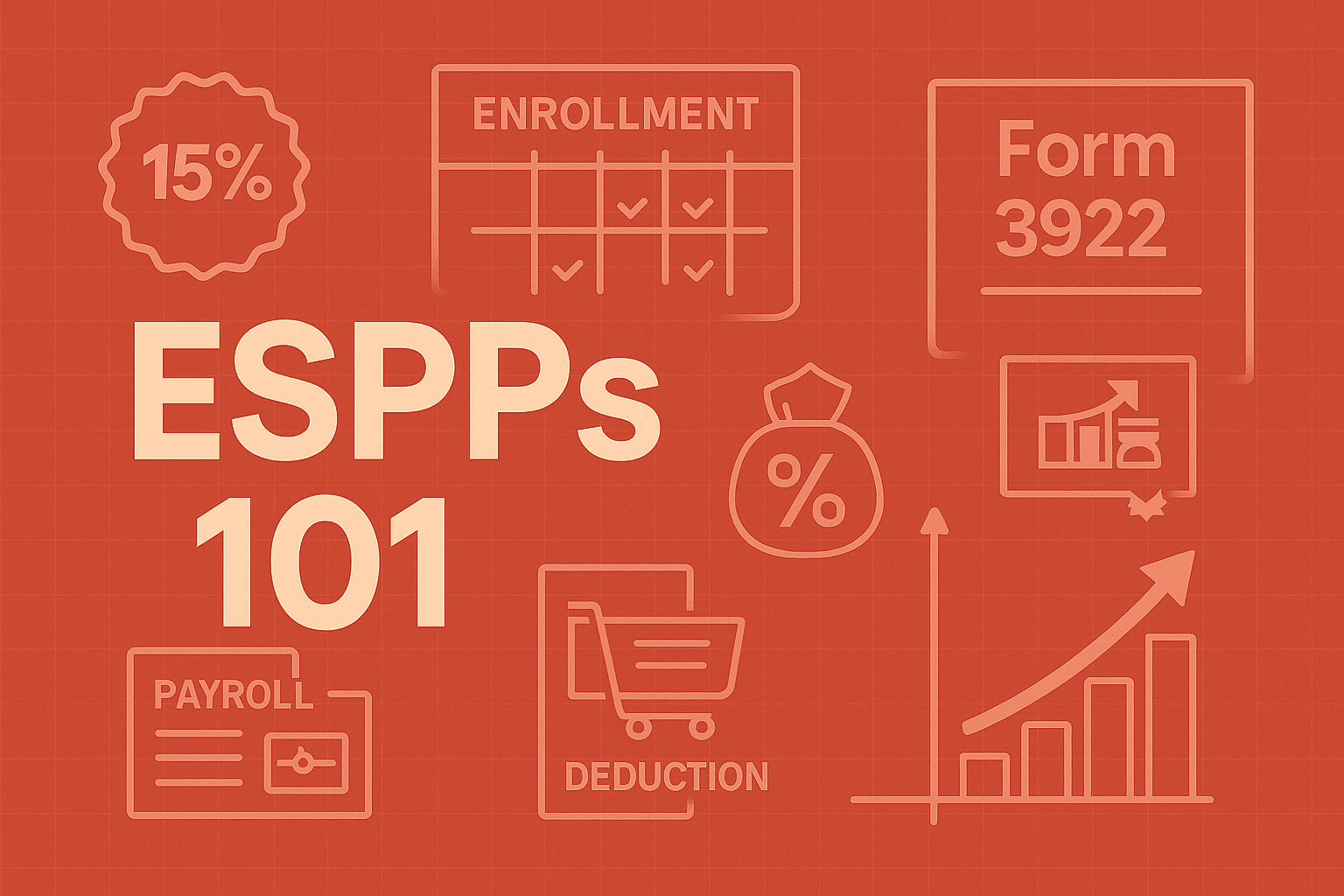
If your company offers an employee stock purchase plan (ESPP), you can purchase shares through payroll at a built-in discount, sometimes with a lookback that boosts value even more. That’s real upside—but it also affects taxes, cash flow, and how much of your wealth sits in one stock.
This guide explains how ESPPs work from enrollment to sale, when taxes show up, and simple choices to keep risk in check while still capturing the benefit.
What Are ESPPs, in Plain English?
An ESPP lets you set aside a slice of each paycheck to buy company stock on scheduled purchase dates, usually at a discount. Many plans also include a lookback, where the discount applies to the lower of the price at the start of the offering period or the price on the purchase date. That feature can stack a discount on top of price appreciation—one reason ESPPs can be attractive.
There are two broad flavors of ESPPs:
Qualified (Section 423) ESPPs: Common in the US; they follow IRS rules, cap annual purchases (based on fair market value at offering start), and may allow favorable tax treatment if you meet holding periods.
Non-qualified ESPPs: More flexible on design, but discounts are typically taxed as ordinary income at purchase with no special holding-period benefits.
Please Note: The big levers you’ll manage are how much to contribute, whether to sell or hold after purchase, and how ESPP shares fit into your broader plan so you capture the discount without letting concentration quietly creep up.
How ESPPs Move From Enrollment to Sale
Step 1) Enroll and pick a contribution rate: During the enrollment window, you choose a payroll percentage (often 1%–15% of eligible pay) up to plan and IRS limits. Your election usually stays in place for the full offering unless you change it at a permitted time.
Step 2) Deductions during the offering/purchase periods: Each paycheck, the plan withholds your elected percentage and parks the cash until the next purchase date. Many plans run 6-month purchase periods inside a longer 12–24-month offering.
Step 3) Purchase at a discount (and possibly with a lookback): On the purchase date, the plan buys shares at the company-chosen discount. The steeper the discount, the more attractive your ESPP will be (at most, 15%, while some companies offer smaller discounts). If a lookback applies, the discount is taken off the lower of (a) price at offering start or (b) price on the purchase date—amplifying value if the stock has risen.
Step 4) Shares settle to your account: You’ll see shares post in your brokerage account after the settlement date, often the next business day. Some plans auto-sell a slice to cover fees or required taxes (more common in non-qualified plans).
Step 5) Decide to hold or sell: After purchase, you can keep the shares or sell them, subject to trading windows, insider rules, and any plan holding restrictions. Your choice affects taxes and concentration risk (more below).
Step 6) Rollover to the next purchase: Unless you change your election, payroll deductions typically continue into the next purchase period automatically.
Lookbacks, Limits, and Sizing Your Contribution
Lookback mechanics (why they matter): A lookback compares the stock price at offering start to the purchase date and applies the discount to the lower one. If the stock rises, you effectively buy at a better than advertised discount —turning a 15% discount (e.g.) into a larger embedded gain. If the stock falls, you still get the discount off the lower current price.
Annual purchase limits: Qualified Section 423 plans cap purchases at $25,000 of fair market value per calendar year, measured using the offering-start price. Plans may also set share or dollar caps and a max payroll rate (often 10%–15%).
Contribution Sizing — A Simple Framework
If the discount is 10% or larger, can you contribute the maximum?: Imagine a bank is offering you six months interest in a CD but it is 2x or 3x more than you can get at a bank. It is only offered to employees of your firm. Would you try to take advantage of it? This is what an ESPP delivers at the end of a settlement period. If you sell the stock immediately (assuming you are free to sell your shares immediately), the after-tax return is much better than your bank offers. All you did was delay that income from your paycheck.
Start with a dollar amount you can spare: Look at your regular bills and savings goals, then decide what you can comfortably give up each paycheck (for example, $500 or $1,000). Convert that to a percentage in your ESPP settings. Starting from a dollar amount keeps day-to-day cash flow steady.
Increase slowly over time: Begin at a modest rate, then raise it by 1–2% every few months. Small step-ups are easier to stick with, and they help you participate more in the plan without feeling a sudden pinch.
Match your money rhythm: Some months are heavier than others—insurance premiums, holidays, or tuition. It’s fine to lower your rate for those periods and raise it afterward. Treat the contribution like a dial, not an on/off switch.
Know your plan’s limit mechanics: Many ESPPs have yearly caps based on the stock price at the start of the offering. If you contribute too aggressively early on, deductions can shut off before year-end. Spreading contributions across the year helps you avoid that surprise.
Don’t crowd out other goals: Keep adding to your emergency fund and contribute enough to get any 401(k) match. If a higher ESPP rate would lead to credit-card balances or skipped essentials, choose the smaller rate. The plan should help your finances, not strain them.
Have a “life happens” switch: If a big expense hits—car repair, medical bill—lower the ESPP rate for a cycle or two. Put a quick reminder on your calendar to bump it back up once things settle so you keep momentum.
Plan around big bills: If a purchase date lands right before a large expense, set your contribution so selling the new shares can cover part of that bill. This turns the discount into planned cash, not leftover stock you forget about.
Public vs. Private Company Realities
Most ESPPs are offered by public companies. A few private companies run ESPP-like programs, but liquidity and taxes work very differently.
Here’s a quick, very high-level look at the core differences:
Public companies: You can usually sell shares on the open market after they settle, subject to trading windows and insider rules. Prices are visible, same-day sell orders are possible, and brokers can automate recurring sales if you set a schedule.
Private companies: There’s typically no public market. You may be required to hold shares until a tender offer, secondary program, or IPO. If the plan is non-qualified, the discount can still be taxed as wages at purchase—even if you can’t sell—so modeling cash needs matters. Transfer restrictions (rights of first refusal, company approvals) also limit what you can do with shares.
Sell or Hold? Simple Frameworks That Work
Cash-out habit: Treat ESPP like a built-in saving tool. When shares settle, sell them and route the cash automatically—some to your emergency fund, some to a diversified investment, and some to near-term goals. This keeps employer stock from piling up while still turning the discount into progress.
Volatility dial: Look at how jumpy the stock has been lately. If swings are big, favor faster selling to cut risk. If the stock has been calm, allow a slightly longer hold. Let the stock’s behavior guide the timing instead of headlines or hunches.
Percent cap: Choose a maximum share of your overall portfolio for employer stock—many people pick 5% to 10%. If you cross that level, trim back within a couple of days. This keeps one company from growing into an outsized bet.
“Lowest-quality lot first” rule: When you do sell, pick a simple order that reduces risk fastest. For example, sell the newest lots first (to stop concentration from building) or the lots that would be least helpful from a tax angle. Using the same order every time keeps decisions clean and quick.
Sideways plan: If the stock drifts sideways for a while, schedule a check-in every 60 days and unwind older shares first. This prevents a slow build-up of stock that never seems urgent but still adds risk over time.
Write it down where you trade: Put your rule in your brokerage notes or keep a short checklist next to your login. If you want to change the approach, update the rule for next time—don’t make one-off exceptions in the moment. This helps you stay consistent without overthinking.
Common ESPP Pitfalls to Avoid
Missing enrollment or change windows: If you don’t sign up (or adjust your rate) during the allowed window, you’ll wait for the next cycle. Put reminders on your calendar for enrollment and contribution-change dates.
Letting concentration creep: Regular purchases add up. Without a sell plan, employer stock can quietly dominate your portfolio. Set an allocation cap and a recurring sell rule to stay balanced.
Assuming you can sell any day: Blackout windows and pre-clearance rules can block sales, especially for insiders. Check your trading calendar before you rely on quick sales to manage risk.
Surprise taxes on non-qualified plans or early sales: In non-qualified ESPPs, the discount is wage income at purchase. In qualified plans, selling too soon makes the discount taxable as ordinary income. Know which plan you have and how your choice to sell affects taxes.
Cash-flow squeeze from high deductions: A jump from, say, 5% to 15% cuts take-home pay more than you expect. Start high only if your budget can handle it, keep a cash buffer, and adjust the rate if monthly bills feel tight.
Sloppy recordkeeping: Tax basis for ESPP lots can be confusing (especially with lookbacks). Keep a simple log with offering start date, purchase date, purchase price, shares bought, and whether you sold in or out of the qualifying window. This makes filing much easier.
ESPP Taxation — What Actually Gets Taxed and When
Tax treatment hinges on whether the plan is qualified (Section 423) or non-qualified, and—if qualified—whether your sale is a qualifying or disqualifying disposition. It’s important to have a clear picture of when taxes apply and what type of income each step creates:
Qualified (Section 423) ESPPs
At purchase: No tax on the discount at purchase.
At sale: Taxes are split between ordinary income and capital gains. Capital gains always apply to what happens to the price of the stock after purchase. Ordinary income applies only to the discount you receive.
Qualifying disposition (held ≥ 2 years from offering start and ≥ 1 year from purchase):
Ordinary income: Either (a) the actual gain (sale price − purchase price) or (b) the lookback discount (price at offer period start − discount %) whichever is lower
Capital gain: Any remaining gain above that ordinary income is long-term capital gain.
Disqualifying disposition (you sell too soon):
Ordinary income: Generally the actual discount you received at purchase (sale price – purchase price).
Capital gain/loss: The difference between sale price and your tax basis after accounting for the ordinary-income portion; character depends on holding period from purchase (short-term if ≤ 1 year, long-term if > 1 year).
Payroll taxes: Section 423 plans generally do not require payment of FICA taxes.
Non-Qualified ESPPs
At purchase: The discount is treated as ordinary wage income when shares are bought (shows up on W-2).
At sale: Future movement from purchase price to sale price is capital gain or loss (short-term or long-term based on holding period).
Payroll taxes: The discount typically requires payment of FICA taxes.
Basis, Holding Period, and Forms
Tax basis: For qualified plans, your basis usually equals the actual purchase price plus any ordinary income recognized at sale. For non-qualified plans, basis generally equals the FMV at purchase (because the discount was already taxed as wages).
Holding period clock: Starts the day after purchase for capital-gains purposes.
Reporting trail: Expect a 1099-B for the sale; ordinary-income portions may appear on your W-2 (non-qualified plans and disqualifying dispositions, plan-dependent). It is a best practice to keep a simple lot log to reconcile for tax prep. Sometimes the brokerage company offers this and you can simply retain it and forward to your (human) tax preparer. At worst, you should start your own log on a spreadsheet (offering start date, purchase date/price, shares, discounts). Sorry guys, online tax preparers are not going to do much beyond reporting what is on the W2 and 1099-B. You better hope those documents are accurate.
ESPP FAQs
What’s a “lookback,” in one sentence?
It lets the plan apply your discount to the lower of the stock price at the start of the offering or on the purchase date—boosting your effective discount if the stock rose.
How much can I buy each year?
Qualified Section 423 plans cap purchases at $25,000 of fair-market value per calendar year, measured using the offering-start price; your plan may also set its own rate/share caps.
Will I owe payroll taxes on the discount?
Generally no for qualified Section 423 plans (FICA/Medicare don’t apply to the discount), but yes for most non-qualified plans.
When do I pay income tax?
Qualified plans: usually no tax at purchase; tax is due when you sell, with a mix of ordinary income and capital gains depending on holding periods. Non-qualified plans: the discount is wage income at purchase, and later movement is capital gain/loss when you sell.
What is a “qualifying disposition”?
A sale ≥ 2 years from offering start and ≥ 1 year from purchase. Part of the gain is ordinary income (generally up to the lookback discount from offering start), and the rest is long-term capital gain.
Can blackout windows stop my sell plan?
Yes. Many companies restrict trading at certain times. If you intend to sell right after each purchase, confirm windows won’t block you—or use a 10b5-1 plan.
What if the stock falls below my purchase price?
You can sell and realize a capital loss (subject to tax rules). Going forward, consider reducing your contribution rate or using a sell-at-settlement rule to limit downside exposure.
Can I change my contribution rate mid-offering?
Plans differ. Some allow mid-period changes or suspensions; others only at set windows. Check your plan document or HR portal for rules and dates.
What happens if I leave the company?
Unpurchased cash is typically returned; already-purchased shares are yours (subject to trading rules). You may miss the next purchase if you’re not on payroll on the purchase date—check your plan.
We Can Help You Make the Most of Your ESPP
ESPPs can add real value when contributions, sell rules, taxes, and risk controls work together. We’ll help you right-size your contribution, choose a clear sell framework, and set guardrails so employer stock doesn’t quietly take over your portfolio. We’ll also coordinate timing with RSUs, options, bonuses, and blackout windows to avoid surprises.
If you want a simple, written ESPP playbook you can follow each purchase period, let’s talk. We’ll model qualified vs. disqualifying sales, outline cash-flow impacts, and align every step with your goals—so your plan turns discounts into progress, not paperwork.