Author Note: This post is aimed at guiding a SMALL group of people. It is mostly relevant if you are in a lower-income year and are also planning to sell an asset like stock, a business, or real estate. In years like this, you do NOT want to miss a chance to save serious money on taxes.
That said, while this may not represent you this year, it could someday soon. That’s especially true if you are retired, retiring, or just earned less than usual while trying to sell something with a large gain.
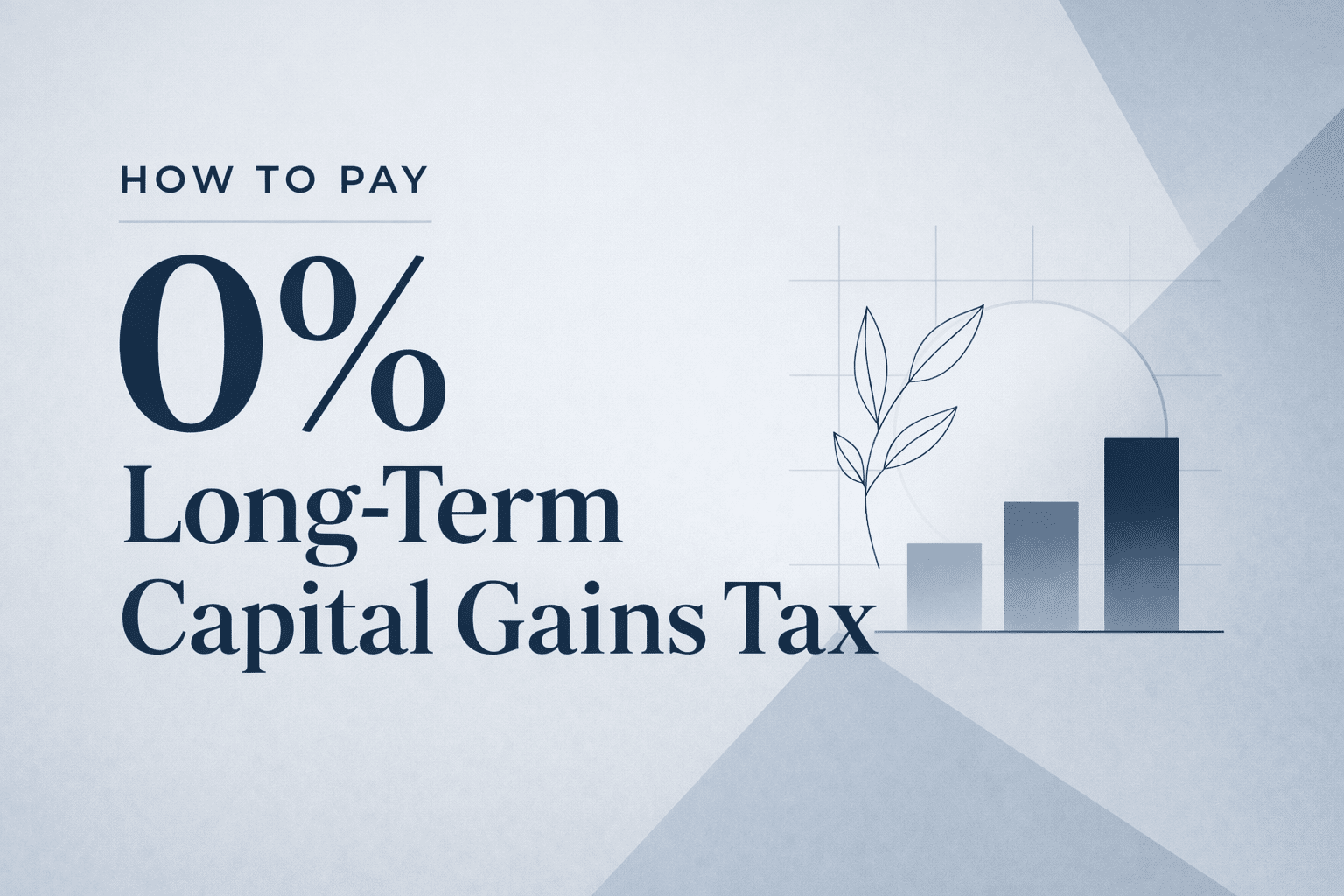
You may have heard some people pay “no capital gains tax.” It’s not some secret, super-advanced loophole. It’s actually MUCH simpler than that. When your taxable income stays under certain limits, long-term gains can be taxed at 0%. Not everyone qualifies, but it’s an opportunity that’s far more accessible than many people think (if you know where to look).
What You Need to Know About Taxes Before Reading More…
Long-term capital gains are not considered “ordinary income”. Instead, they fall into a category called “investment income”. The main kinds of investment income where you can experience preferential tax rates fall into the following categories:
Long-Term Capital Gains
Qualified Dividends
Municipal Bond Interest
There are a few other very rare categories, but these are the main ones. You pay a different tax rate for long-term capital gains than you would your ordinary income. Sometimes it can be as low as 0%!
Generally, long-term gains are profits on assets you held for more than one year before selling them. If you held the asset for one year or less, the gain is usually short term and taxed at ordinary income rates instead. However, to truly understand how your long-term capital gains will be taxed, you also need to understand the total amount of “taxable income” you have.
What is Taxable Income?
Taxable income is the portion of a person’s income (both ordinary income and investment income) that remains after subtracting allowable deductions. Taxable income is the final figure you pay tax on, BUT, you pay different tax rates on your various kinds of taxable income(s) [i.e., ordinary income, investment income, unearned income, etc.]
For 2026, the IRS says the 0% long-term capital gains rate applies if your taxable income is at or less than:1
$49,450 for single filers,
$98,900 for married couples filing jointly,
$49,450 for married filing separately, and
$66,200 for heads of household.
Above those levels, most long-term gains generally move into the 15% bracket, and higher income taxpayers can eventually reach the 20% bracket.
Putting Opportunity into Practice
So, if your taxable income is lower than those figures, AND you want to sell an asset, you could sell some of it and avoid capital gains tax.
Here’s the simplest way to think about it:
Step 1) Before year-end, work with an advisor to forecast your taxable income after deductions.
Step 2) See how much room is left before you hit the 0% capital gains ceiling (if any).
Step 3) What remains is the amount of long-term gains that can potentially be taxed at 0%.
So when people say they “got away with” paying 0% on capital gains, what usually happened is not anything shady (hopefully). They simply had enough room left in the 0% bracket for some or all of their gain to fall into it.
A Simple Married Filing Jointly Example
Let’s say a married couple filing jointly in 2026 has wages of $112,200 and takes the standard deduction of $32,200. That would leave $80,000 of taxable ordinary income.
The 2026 0% long-term capital gains ceiling for married couples filing jointly is $98,900.
That means this couple has: $98,900 – $80,000 = $18,900 of room left in the 0% long-term capital gains bracket.
If they sell investments with a $15,000 long-term capital gain, the full gain fits under that ceiling, so the federal tax on that gain would generally be $0.
If they instead realize a $30,000 long-term capital gain, then the first $18,900 would generally fall in the 0% bracket and the remaining $11,100 would generally be taxed at 15%.
The People Most Likely to Pay No Long-Term Capital Gains Tax
Retirees in low-income years: Someone living on withdrawals from their bank, a brokerage account, or a modest amount of income may have very little taxable ordinary income in a given year. That can leave a surprising amount of room for long-term gains at 0%.
Early retirees: Those retiring early can also benefit during the gap years after work ends but before required minimum distributions or larger Social Security taxation kicks in. Those years can create a window where taxable income is low enough to harvest gains at favorable rates.
People with large itemized deductions: Given the 0% test uses taxable income, not gross income, a household with meaningful itemized deductions may still have room for gains at 0% even if total cash flow is not especially low.
Where the Strategy Can Break Down
Short-term gains: If you held the asset for one year or less, the gain is generally taxed as ordinary income (between 10% and 37%) not at the preferential 0%, 15%, and 20% long-term rates.2
State rules: State taxes may also apply. Even if your federal long-term capital gains rate is 0%, your state may still tax the gain. That is one of the easiest ways people overestimate how “tax free” a sale really was. Federal and state treatment are not always the same.
Other Legal Ways People Reduce or Eliminate Capital Gains Tax
The primary residence exclusion: If you meet the IRS rules, you may exclude up to $250,000 of gain from the sale of your main home, or up to $500,000 if married filing jointly.3
Inherited assets: Assets you inherit can also receive a basis adjustment at death, which can sharply reduce taxable gain for heirs if they sell later. Capital gains tax is based on the difference between sale price and adjusted basis, so basis is one of the most important numbers in the entire calculation.
Capital losses: Capital losses can offset capital gains, and if losses exceed gains, up to $3,000 of excess net capital loss can generally reduce other income each year, with additional losses carried forward.4
The Cost of Missing These Opportunities (In-Depth Example)
If you have a high income, it’s possible that you may benefit from this only a handful of years, perhaps never. And since it is rare, most people sit on their hands and miss out on mega tax savings.
Background
A married couple retired in February after a long career earning high wages working at XYZ Tech Company. Over the years, they received lots of company stock while working there, and they hardly ever sold it.
Here’s where they presently stood:
Year-to-date earnings before retiring in February = $20,000 ordinary income
Expected earned income the rest of 2026 = $0
They have $250,000 in cash that’s expected to yield interest of just $2,500 this year.
It costs them $15,000 a month to live and they use the cash to pay their cost of living.
They have 2,000 shares of XYZ Tech Company. The stock price is currently $500 a share and totals $1million in market value. The purchase history breaks down as follows:
500 shares were purchased at $150 a share over a year ago
500 shares were purchased at $250 a share over a year ago
500 shares were purchased at $400 a share over a year ago
500 shares were purchased at $550 a share within the last year
Problem
They understand it would be best to reduce the size of this stock in their portfolio by $750,000 but are hesitant because they are worried about paying a large tax bill.
If they did nothing, their taxable income by years’ end would be $0.00:
$20,000 ordinary income they earned prior to retiring
$2,500 interest income (taxable as ordinary income)
Standard Deduction = $32,200
Solution
But if they did the math, they could sell all $750,000 and pay only $6,210 in total tax for the year; succeeding at diversifying their portfolio for a mere 3.6% tax rate on all their income for 2026.
|
Marginal Rate |
Taxable Income Threshold |
Taxable Income |
Qualified Income |
Tax |
|
0.0% |
$0 to $98,900 |
$98,900 |
$0 |
|
|
15.0% |
$98,900 to $613,700 |
$140,300 |
$41,400 |
$6,210 |
|
20.0% |
$613,700 and above |
$0 |
$0 |
|
|
Total |
$140,300 |
$6,210 |
Conclusion
Had they waited to sell their stock deeper into their retirement, they would have paid a much higher rate on the realized long-term gains.
The biggest takeaway is that by understanding how the system already works, you can pay much lower tax bills by bunching income into your low earning years at a very low (possibly 0%) rate. Once you know that the 0% rate depends on taxable income, and once you see how deductions and timing affect the math, the outcome starts to look a lot less mysterious.
How Our Team Can Help
Paying 0% on long-term capital gains is possible, but the opportunity usually comes down to timing, income coordination, and not making avoidable mistakes. A sale that looks harmless on its own can affect other parts of the return, while a well-timed gain can create real long-term tax savings.
That is where planning becomes more valuable than rules in isolation. Our team can help you look at capital gains in the context of your full financial picture, including retirement income, deductions, investment positioning, and the tax impact of selling in one year versus another. If you want help building a smarter withdrawal and tax strategy, schedule a complimentary consultation with our team.