If your compensation includes NSOs, you’ve been granted the right (not the obligation) to buy company stock at a fixed exercise (strike) price. If the market price rises above that strike, you can buy at the lower price and keep the difference. This guide walks through each stage from grant to sale, how taxes actually apply, and the decisions that matter most for timing, cash flow, and diversification.
What Are NSOs, in Plain English?
With NSOs, your company gives you the right to purchase a set number of shares at a specific strike price within a defined window (often 10 years from the grant date). Over time, your options vest, meaning you gradually gain the right to exercise them. Once vested, you can buy shares at the strike price — and either sell right away or hold for potential future gains.
The key difference from incentive stock options (ISOs) is taxation: when you exercise NSOs, the “spread” between the stock’s fair market value and your strike price is taxed as ordinary income. This amount shows up on your W-2 and is subject to payroll taxes. If you keep the shares after exercising, any later increase or decrease in value becomes a capital gain or loss when you sell.
How NSOs Move From Grant to Sale
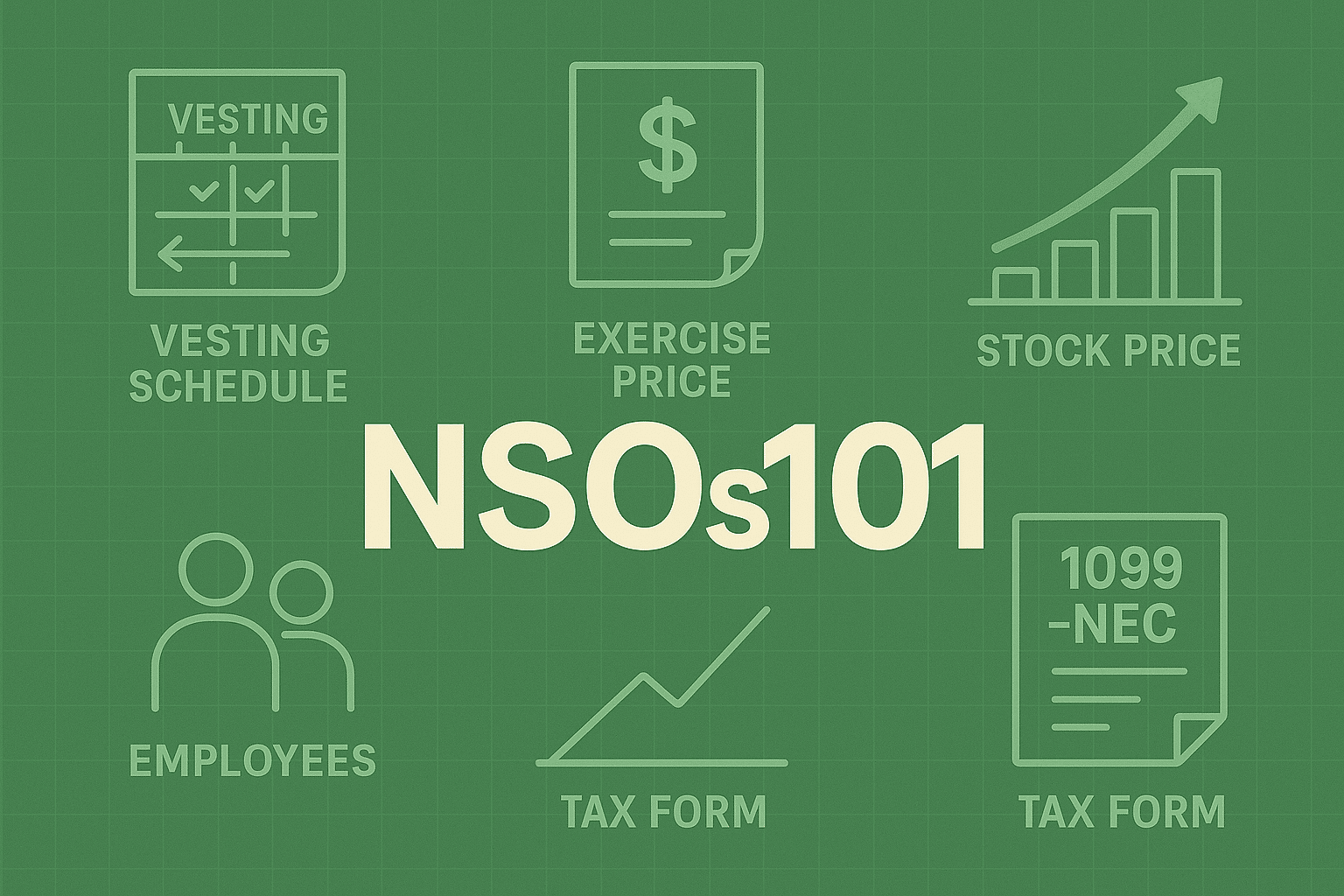
Step 1) Vesting: Your grant lays out the strike price, number of options, and expiration (often 10 years). A vesting schedule—cliff, monthly, or quarterly—controls when you gain the right to exercise. Unvested options generally can’t be used unless the plan allows early exercise.
Step 2) Exercising: Once vested, you buy shares at the strike. For employees, the spread at exercise is W-2 income subject to federal and state withholding plus FICA/Medicare; contractors report it as non-employee compensation. You can fund the exercise with cash, a same-day sale, sell-to-cover, or plan-permitted net exercise.
Step 3) Selling: Sell immediately and most of your gain is already taxed as wages; any small difference from execution price is capital gain or loss. Hold the shares and future movement becomes capital gain or loss at sale (short-term if held one year or less from exercise, long-term if more than one year).
Step 4) Expiration and termination: Options lapse at expiration or if you miss the post-termination exercise window after leaving the company (often 90 days to 12 months for NSOs, plan-dependent). Know your dates—lapsed options are gone.
Exercise Methods (Cash, Cashless, and Net)
Once you understand the basics, pick an operational path that matches your liquidity, trading constraints, and share-count goals. Here are the primary methods and when they fit:
Cash exercise and hold: You fund strike and any required withholding from cash, receive full shares, and begin the capital-gains clock at the exercise FMV basis. Best when you have ample liquidity and have decided you want to be an “investor” in the company stock.
Same-day exercise-and-sell: A coordinated broker flow executes exercise and an immediate sale. Minimizes market exposure and cash needs, aligns with diversification targets, and avoids carrying shares through blackout periods.
Sell-to-cover: You exercise, sell just enough to fund strike/withholding, and retain the balance. Useful when you want future upside but need the transaction to be cash-neutral. Confirm that the calculation includes your state/local rates, not only federal flat rates.
Net exercise (plan-dependent): The plan retires a portion of options equal to the strike/withholding value and delivers the net shares—no market trade needed. Share count is lower versus cash or sell-to-cover, but operationally simple.
Operational guardrails: Verify trading windows, insider policies, and any active 10b5-1 plan before you rely on same-day or sell-to-cover. Pre-clearance/MNPI rules can block sales even when options are exercisable.
Execution details: Order type, bid-ask spreads, and commissions can affect proceeds and the withholding math. For large tickets, coordinate with the broker on staging to control slippage and funding.
Public vs. Private Company NSOs
Company stage changes valuation, liquidity, compliance, and timelines. Use this side-by-side to align expectations and plan ahead:
Price and Valuation
- Public: Real-time market price sets FMV; quotes enable precise same-day flows.
- Private: FMV comes from the company’s 409A appraisal (periodically updated after material events).
Liquidity Path
- Public: Open-market sales during trading windows; 10b5-1 plans can automate timing.
- Private: Liquidity depends on company-approved tender offers, secondary programs, or a future IPO/acquisition; capacity and eligibility may be limited.
Trading and Compliance
- Public: Rule 144, insider policies, blackout windows, and MNPI controls govern when officers/insiders may trade. Cooling-off and amendment rules apply to 10b5-1 plans.
- Private: Transfers often restricted by rights of first refusal and investor agreements; sales require company approval and may face discounts or caps.
Withholding and Funding
- Public: Withholding typically processed via sell-to-cover or same-day flows; confirm state/local layers are captured.
- Private: Exercising before liquidity creates wage income without guaranteed cash; model strike + withholding funding and the probability/timing of a tender well in advance.
Post-Termination Windows
- Public: Windows are plan-defined; liquidity usually exists when windows open, subject to blackout periods.
- Private: Windows vary widely (e.g., 90 days to 12 months). If a 409A refresh raises FMV while you wait, later exercises may require more cash for withholding.
409A Guardrails
- Public: Grants generally align with observable market FMV on grant date.
- Private: Strike must be at or above 409A FMV to avoid Section 409A penalties; confirm documentation for repricings or extensions before exercising.
Tender Offers and Secondaries
- Public: Not applicable—sales occur on-exchange.
- Private: Company-approved events can enable partial liquidity but may cap allocations, apply discounts to FMV, or prioritize certain holders. Plan which grants/lots you’ll tender first and whether proceeds will fully cover earlier exercise-related tax outlays.
Planning Moves That Add Real Value
Strong NSO outcomes come from lining up cash needs, trading rules, and portfolio risk before you press “exercise.” Use the checklist below to turn one-off decisions into a simple, repeatable playbook:
Tax modeling before action: Estimate wage income from the spread, FICA/Medicare, and any gap between supplemental withholding and your marginal rate, then decide whether to adjust paycheck withholding or make quarterly estimates.
Cash-flow map: Tally strike, expected withholding, and broker costs by grant and lot, and choose in advance whether you will fund with cash, a sell-to-cover, or a same-day sale so execution isn’t rushed.
Concentration guardrails: Define a maximum employer-stock allocation and prewrite trim rules (percentages, time intervals, or price bands) so diversification happens automatically after run-ups.
Window and policy readiness: Confirm trading-window dates, pre-clearance needs, and any MNPI restrictions, and decide whether a 10b5-1 plan should schedule exercises or sales during open windows.
Coordinate with other equity: Sequence NSO activity with RSU vests, ESPP purchases, bonus payouts, and option expirations to smooth taxable income across years and avoid stacking events into one quarter.
Goal-based routing: Assign each planned exercise or sale to a concrete use—tax reserves, debt payoff, down payment, or diversified purchases—so proceeds do not drift back into concentrated stock.
Recordkeeping maintenance: Maintain a simple log of grant IDs, vest and exercise dates, FMV at exercise, shares delivered/sold, and broker confirms to reconcile W-2 and 1099-B reporting cleanly at tax time.
Early Exercise and 83(b) Elections
Some plans allow you to exercise unvested NSOs and file an 83(b) election; this can front-load tax at a small spread and start the capital-gains clock sooner, but it also shifts risk to you. Before pursuing this path, anchor on these points:
When it is possible: Early exercise must be explicitly permitted by the plan; if allowed, you may purchase unvested shares and begin the holding period immediately upon exercise.
Filing deadline: The 83(b) election must be filed within 30 days of the early exercise with no extensions, so prepare the form, mailing method, and proof of filing before you transact.
Tax effect at low spread: When FMV is close to strike, wage income at exercise is minimal, which can position more of the future appreciation to be taxed as capital gain if you later sell after one year.
Forfeiture and liquidity risk: Because you pay for unvested shares up front, leaving the company or facing delayed liquidity can lock in a cash outlay without a near-term way to recover it.
Private-company valuation: FMV derives from the latest 409A appraisal; a subsequent 409A increase can make later grants or exercises more expensive from a wage-income standpoint.
Suitability filter: Early exercise tends to fit when spreads are tiny, you have ample runway and cash cushion, and you are comfortable carrying company risk until a clear liquidity event.
NSO Taxation — What Actually Happens
Two moments drive taxes with NSOs—when you exercise and when you sell. To keep surprises off your return, know what’s treated as wages, what becomes capital gains, and how basis and holding periods fit together. Here’s the high-level picture:
Tax timing and character: Exercising creates wage income on the spread; selling later creates capital gain or loss on the post-exercise movement.
Basis and holding period: Your per-share basis becomes the fair market value at exercise (lot by lot). The long-term clock starts the day after exercise and turns long-term after one year.
Payroll/withholding scope: The spread is subject to federal and state income-tax withholding and to FICA/Medicare (up to applicable caps). Supplemental wage rates may under-withhold relative to your marginal bracket.
Reporting trail: Employees see the spread on Form W-2; the eventual sale appears on Form 1099-B. Keep lot-level exercise records to reconcile basis at tax time.
Alternative minimum tax (AMT): NSOs do not trigger AMT at exercise (AMT exposure is an ISO issue).
Please Note: State/local rules and, if you hold then sell, potential 3.8% net investment income tax (NIIT) depending on your AGI.
Common NSO Pitfalls to Avoid
Most costly errors stem from timing and process rather than market swings. Keep the following on your checklist to reduce avoidable headaches:
Under-withholding at exercise: Supplemental rates may trail your true bracket, so plan top-ups via paycheck changes, estimated payments, or a sell-to-cover sized for federal, state, and local layers.
Blackout and MNPI surprises: If you expect a same-day sale to fund taxes, being in a blackout or holding MNPI can block selling, so verify window status and pre-clearance before exercising.
Missing post-termination windows: After separation, exercise periods are plan-defined and can be short; track dates by grant and arrange funding ahead of time to avoid lapse.
Overconcentration: Exercising and holding without preset limits lets one stock dominate your net worth, so use written allocation caps and automatic trim rules.
Sloppy basis tracking: Without lot-level FMV-at-exercise records, reconciling broker 1099-B data and reporting capital gains becomes error-prone, so save confirmations and update your log after every transaction.
409A and grant hygiene: Option strike must be at or above FMV on the grant date; for repricings or extensions, request documentation that preserves 409A compliance before you act.
Cash squeeze at private firms: Exercising before clear liquidity can create a real tax bill without proceeds, so model worst-case timelines and consider waiting for tenders if cash is tight.
Non-Qualified Stock Options (NSOs) FAQs
How do I know if my options are “in the money”?
Your options are in the money when the current fair market value of the stock is above the strike price; if the value is below the strike, exercising would not create economic gain.
What forms will I receive at tax time?
Employees typically see the exercise spread on Form W-2 and the eventual sale on Form 1099-B from the broker; keep lot-level records so your cost basis and holding periods match the 1099-B detail.
Do payroll taxes apply when I exercise?
Yes. The spread at exercise is wage income subject to federal and state withholding and to FICA/Medicare up to applicable caps; later gains after exercise are capital gains when you sell.
Can I avoid a surprise tax bill if withholding is too low?
You can increase paycheck withholding, make quarterly estimated payments, or size a sell-to-cover to include federal, state, and local layers; pick one method and monitor it against your projections.
What happens if I exercise during a blackout window?
You may be able to exercise, but selling to fund taxes could be restricted; confirm trading-window status and pre-clearance rules before relying on a same-day or sell-to-cover flow.
How do NSOs interact with my RSUs or ESPP?
Coordinate timing so large RSU vests, ESPP purchases, bonuses, and NSO exercises do not stack into the same quarter; spreading events can smooth taxable income and cash demands.
What if I leave the company—how long do I have to exercise?
Post-termination windows are plan-defined and can be short; track dates for each grant, line up cash or a sell-to-cover plan, and act before the window closes to avoid lapse.
Is early exercise with an 83(b) filing always a good idea?
No. It can be attractive when the spread is minimal and you have a long runway and cash cushion, but it shifts risk to you if you leave before vesting or if liquidity arrives later than expected.
Can I use a 10b5-1 plan with NSOs?
Yes. A 10b5-1 plan can schedule exercises and sales during open windows and help you keep diversification on track; confirm cooling-off and amendment rules with your broker and company.
How should I decide how many options to exercise at once?
Model cash needs, withholding, and concentration targets by lot and date, then size exercises to fit your guardrails rather than the maximum available; staggering across periods can reduce risk.
We Can Help You Make the Most of Your NSOs
NSOs pay off when the moving parts—tax timing, trading windows, cash needs, and portfolio risk—work together. We build a straightforward plan that models wage income at exercise, sets funding and diversification rules, and maps actions to your goals so you are never guessing under a deadline.
If you already work with a CPA or attorney, we will coordinate; if not, we can introduce trusted partners. When you are ready for a simple, step-by-step NSO strategy you can follow with confidence, schedule a complimentary consultation with our team and we will get started!